When does stainless steel rust, what makes a weld blacken and other interesting facts
“Gaschema”, a production company of industrial, welding, food, medical and special gases and their mixtures, has started cooperation with Vilnius Gediminas Technical University (VILNIUS TECH). After mutual agreement on various joint trainings and seminars, nine members of “Gaschema” team came to the first course of training about the welding gases and their mixtures, which was presented to the colleagues by Dr. Irmantas Gedzevičius, associate professor of Department of Mechanical and Materials Engineering of VILNIUS TECH.
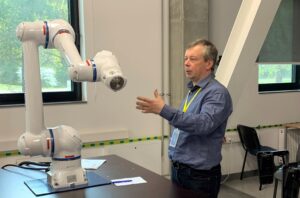
The training took place not in the usual training as a seminar form, but in the form of consultations: colleagues asked questions that are usually asked by customers buying the services of the company or products. Dr. I. Gedzevičius analysed them from a scientific point of view – while answering the questions, he explained the reasons for certain processes and challenges, in which cases the presented situation is related to facts, and when to widespread myths only.
According to Diana Sabinskienė, Marketing Manager of “Gaschema”, most of the time of the meeting was dedicated to the discussion about welding gases, their mixtures and how, depending on the product used, the course of the welding process, the efficiency and the achieved result depend on it.
“From time to time, our colleagues from the sales receive complaints from customers that argon is of poor quality, because it produces a black weld during the welding process. It turns out that this is not caused by the quality of argon, but by the welding process itself. The lecturer explained that the black seam can be caused by moisture, as well as even the slightest gust of wind, which can also be caused even by doors being opened and closed. When shielding gas is blown or in the presence of moisture, the metal oxidizes and the weld seam turns black. Not to mention the fact that, taking into consideration the previously mentioned factors, it is necessary to perform such welding works in closed premises,” emphasized D. Sabinskienė.
The representative of VILNIUS TECH also talked about various scientific research related to gas with hydrogen or gas with helium, demonstrated how and when stainless steel can rust, etc.
“Although I don’t weld myself and I don’t do such jobs at work, moreover, I only come across the topic of welding gas when I need to prepare some kind of advertising material, I was still completely involved during all the training – even complex, specific information was presented here in a very interesting, simple way, basing the facts on explanations and scientific evidence and research,” explained D. Sabinskienė.
After the training, the employees of “Gaschema” took part in a tour of the university: the colleagues were most interested in the opportunity to see up close what is happening behind the doors of the university laboratory.