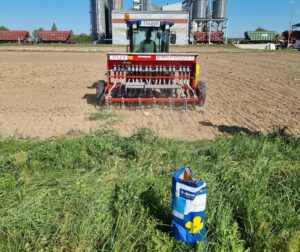
New season in Viduklė production trial fields
At the end of August, a new collection of seven different winter rapeseed species was sown in the production trial fields in Viduklė. Company “Agrochema” is launching an important research process, which will aim to determine which rapeseed species are the most suitable for certain growing conditions. The research will encompass the evaluation of both agronomic characteristics such as disease and pest resistance and environmental factors such as climate, soil composition and the level of moisture.
The head of Crop Production Department of “Agrochema” Mantas Mačėnas, stated that, in order to ensure high yield and resistance to adverse environmental conditions, breeders and agronomists are constantly looking for new ways to improve the rapeseed species.
“We want to test different species under real growing conditions: to evaluate the existing ones and to compare them with competitors and newcomers to the market. BASF, DEKALB and RAPOOL species were sown as part of the collection this year,” told M. Mačėnas.
After the seed sowing a long trial assessment process will commence. The primary assessments will also be repeated in autumn, when the plants sprout and start growing. At this point of time, it is important to assess the uniformity of germination, plant density and growth rate. During the winter, it will be observed how the plants tolerate low temperatures and other stressful conditions.
In spring, when the intensive growth spur of the plants commences, additional assessments will be carried out. Plant height, branching, resistance to diseases and pests, recovery after winter will be evaluated. Later, before the harvest, yield and oiliness tests will be carried out, which are the most important for the final assessment of the species.
“We will select the species that have the best characteristics taking into consideration the test results. These species will be recommended for the farmers as the most perspective under certain growth conditions”, explained the Head of Crop Department Mantas Mačėnas.
It is planned to share the test results with the selectionists as well, since for them that is substantial support for creating new species that would meet the expanding requirements of the agricultural sector.