Agrochema takes a step towards greater operational excellence: focusing on processes and performance
Agrochema has launched a new operational excellence initiative aimed at improving day-to-day processes, enhancing business performance and increasing employee engagement. The programme is intended to become a long-term effort that fosters a culture of continuous improvement and encourages employees to systematically refine the way work is carried out across the organisation.
“While operational excellence is often associated with LEAN and other management methodologies, our ambition goes far beyond that. Above all, it is a shift in mindset – a commitment to doing better than yesterday, seeking more effective solutions, reducing waste and creating greater value for customers, employees and the organisation as a whole,” says Laura Andriejavienė, Business Process Auditor at Agrochema.
The first phase of the initiative will focus on Agrochema’s grain elevator and laboratory operations. These teams work closest to the processes, possess in-depth knowledge of day-to-day activities, identify opportunities for improvement and play a direct role in the organisation’s overall performance.
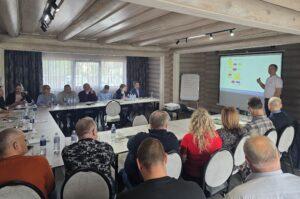
During the first training sessions held at the end of May for managers of the selected business units, key operational areas and challenges were identified. The newly introduced operational excellence tools will help address these issues and support further improvements.
In practice, Agrochema employees are already applying several operational excellence tools. One of the best-known examples is the “Ideas Bank”, which encourages employees to propose practical improvements that deliver measurable results. Other initiatives include process analysis and optimisation, automation and digitalisation of workflows, as well as active employee involvement in identifying problems and developing solutions.
“In the first phase, a dedicated working group will analyse production, laboratory and grain elevator operations, apply various operational excellence tools in practice and seek solutions that generate the greatest value. Most of the learning will take place in the real working environment, where we will address specific day-to-day challenges and actively involve employees who know the processes best and face these challenges every day. The results achieved during this stage will pave the way for the continuation of the operational excellence programme,” explains Laura Andriejavienė.
“Operational excellence is particularly important for companies committed to sustainable growth and continuous improvement,” says Paulius Stonis, Sustainability Manager at Achema Group. “I believe Agrochema’s improving results in recent years clearly demonstrate this commitment. By pursuing operational excellence in a more structured, disciplined manner and drawing on proven international best practice, even stronger results can be achieved.”
According to Mr Stonis, the ambition to begin systematically implementing operational excellence principles across Achema Group has been developing for some time. When identifying the most suitable company within the Group to launch the initiative, particular attention was given to experience in process improvement. Due to the complexity of its operations and its long-standing commitment to process optimisation and automation, Agrochema was selected as the starting point.
“Our objective is to work closely with the Agrochema team to build expertise within the organisation so that, in the future, operational excellence initiatives can be championed by managers from other business units, programme coordinators and internal mentors. Experience from both Lithuanian and international companies shows that operational excellence programmes do not deliver results overnight, or even within a single month. However, when there is a dedicated team supported by management and actively engaged employees, significant improvements and stronger business performance can be achieved over time. Customer service and retention improve, working conditions become safer and more convenient, and organisations benefit from savings in both time and costs,” says Mr Stonis.
Ms Andriejavienė emphasises the importance of employees actively sharing best practices and success stories, while working together to identify opportunities for improvement. As laboratory, grain elevator and production employees and managers possess the deepest understanding of their day-to-day processes, are most familiar with operational challenges and are best placed to propose practical solutions, they are expected to play a key role in analysing processes and developing improvements.
The implementation of operational excellence practices will be guided by the 70–20–10 learning model. Under this approach, 70 per cent of learning will take place through practical experience in the workplace, 20 per cent through peer learning and knowledge-sharing within the organisation, and 10 per cent through external training programmes. The aim is to ensure that operational excellence becomes not a one-off initiative, but an integral part of everyday work.
Experience in Lithuania and internationally demonstrates that the formal application of operational excellence tools alone does not produce sustainable results. Meaningful change begins when employees themselves are motivated to find better, simpler and more efficient ways of performing their work.