Agricultural experts: restrictions on plant protection products – a risk or an opportunity for Lithuanian farms?
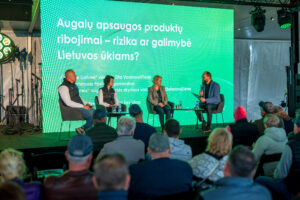
On the occasion of Customer Day, “Agrochema” organized several discussions on agricultural topics relevant to farmers, producers, and scientists. One of these discussion was dedicated to discussing the plant protection situation. This discussion was attended by the CEO of “CropLife Lietuva” Zita Varanavičienė, Business Client Manager of UAB “Bayer” Povilas Viganauskas, the Head of Crop Production Department of “Agrochema” Rasa Stefanovičienė. The discussion was moderated by Ugnius Savickas.
The CEO of “CropLife Lietuva” Zita Varanavičienė commenced the conversation by mentioning that since 2020 any discussion and any scientific report starts with a reference to the green course and the most important listed goals include decreasing the usage of fertilizers and pesticides. “However, we are now living in the period of the next European Commission term, and the green course is replaced by the course suggested by Mario Draghi, i.e. the course comprising competitiveness, promoting innovation and reducing bureaucracy. We probably missed that from 2020 to the end of 2024. The report of Mario Draghi proposes to reduce bureaucracy by 25 percent for all companies and 35 percent for small companies” introduced the situation Z. Varanavičienė.
According to her, great attention is paid to promoting competitiveness, whereas the report prepared by Mario Draghi establishes that if the European Union does not invest 800 billion EUR into innovation and new technologies per year, we will face slow agony.
“Talking about plant protection products, we are in a very big “Titanic”. We essentially see an iceberg, but inertia and mass are so big that we are unable to turn the ship away. The implemented plant protection product, active component monitoring program and situation is rather sad as every year we lose more active components than new ones appear. Because creating new active components is not that easy. The requirements are high, whereas the solution (what the politicians like to identify very often) involves biological products that might solve all the problems, which is not to be implemented so quickly and easily. Most probably this solution will solve some of the issues, but most definitely not all the problems, and initially this solution will work in greenhouses, where the humidity, ultraviolet radiation and etc. are controlled. To sum it all up, we are facing a situation, when have to turn this “Titanic” somehow” explained Z. Varanavičienė openly and relying on metaphors.
The moderator of the discussion raised the question of how this policy (without changing anything) affects economic entities. Addressing representative of “Bayer” Povilas Viganauskas, he emphasized that the policy is not new. Registration is revoked for one product, then another. “As manufacturers of plant protection products, what forecasts do you have, how would you suggest preparing for the new season?” the moderator addressed a question to P. Viganauskas.
“Until approximately 2030 their future does not seem very bright, since the green course was very strict, strong and had huge negative impact. Such big companies manufacturing plant protection products as ours were forced to revise the strategies, adopt certain solutions and due to that we were even forced to suspend the registration of some products. We introduce innovations, make efforts in order to ensure that the farmers have an option, but we must admit that sometimes we are hostages to the rules and cannot always offer our farmers the same solutions as our neighbours in Poland, and even more so in France or Germany. Since Lithuanian farmers compete with farmers from all over Europe and even the world, due to the political situation that has developed, which was very green, today we are in a situation when sometimes we are in a worse situation than our closest neighbours” emphasized P. Viganauskas.
According to him, everybody sees our country as one of the Baltic States and we seem little in comparison to our neighbour Poland. Therefore, it is difficult to compete and it is not always to determine, how the situation can be improved. “Nevertheless, we invest money and create new products, since we are also creators and will retain this mission. We invest from 2.2 to 2.7 billion EUR. We seek to create something more” the representative of “Bayer” was very optimistic.
Challenges
When transferring to another topic the moderator of the event inquired what challenges pose a threat in the plant protection field when this “Titanic” sails away, i.e. under the changes of the policy that cannot be completely altered so quickly, but must be taken into consideration, must not be forgotten when considering what we should prepare for.
When entering the discussion the Head of Crop Production Department of “Agrochema” Rasa Stefanovičienė noted that the list of plant protection products is extremely long (if talking about the brand products), nevertheless, we are considering the active components and the fact that their number in the market is decreasing as they get deregistered.
“Visually the list of brand products probably not short, there are quite many new products with the same active components being registered, but how should the situation be managed, how the weeds, diseases and pests should be controlled? In my opinion, the first thing you need to do is not buy a product of a certain brand but focus on the active components of the product. Take a closer look at the principle of their action. For example, when analysing the composition of herbicides, fungicides or insecticides of several brands even when they have active components of different names, it might turn out that the principle of their operation according to HRAC; FRAC; IRAC (Herbicide; Fungicide; Insecticide Resistance Action Committee) is the same. If we keep on using them for a several years in a row, we will be pre-programming another major problem, which we are already facing now – enormous resistance of weeds, fungal diseases, and pests to plant protection products. Undoubtedly, the most acute problem is weed resistance to herbicides” R. Stefanovičienė listed specific problems.
Nevertheless, she is open about the fact that we do have such a list of products as it is. Once certain active components are deregistered, we will only have permitted components, consequently there is no longer the luxury of losing even 1 g of active component. Original products are able to ensure that, since the active component is not everything, there are also the accompanying additives which increase the efficiency of the active component, spreading and penetration possibilities, and reduces losses due to, for example, rain. Accompanying additives also suppress the acute effects of certain active components on the plant.
“We will simply have nothing else to do, nothing to choose from, so let’s use the products we already have responsibly and in accordance with the registered norms. Let’s not decrease the norms. Because from scientific point of view, we face resistance when, when by decreasing the norm, we gradually develop such norm effect, when even the maximum norm possible does not ensure the result. The resistance is not a disease or a virus; it is merely a complex of incorrectly selected agrotechnical measures” explained the representative of “Agrochema”.
Zita Varanavičienė interrupted by adding that the biology of microorganisms is such that they tend to adapt to existing conditions. During COVID-19 pandemic, we learned (farmers knew this) that viruses mutate, change, and adapt to the environment, and it resembles a cat-and-mouse game, but what we can do is use precise technologies, use plant protection products according to the recommendations on the label, which will simultaneously protect against the rapid development of resistance.
“Our goal is to stop faster development of resistance, but that task is not so simple, since the equipment is transported as well as the seeds, moreover, they are also transported by air. Thus, these are probably already signals that we have widespread slender meadow foxtail, which is a weed that destroys a large portion of crop. It is known to be resistant to certain herbicides, thus maintaining the product range so that we can adhere to a certain technology, which is extremely important” emphasized Z. Varanavičienė.
Addressing the representative of “Bayer”, the moderator asked whether new active components were being developed. “Registering something new in the European Union according to the valid requirements and placing it on the market is not easy, and when it comes to Lithuania and the Baltic countries, it is even more difficult. I will admit that there are huge efforts to be made. For one of those efforts the result is a new insecticide that we worked very hard to register for 3 years. Finally we got the opportunity to have it. An agreement has already been reached with State Plant Protection Service and the final label for the future product has been approved. I think this will make you happy, because registration for wheat and rapeseed before flowering will expand. As for legumes, regarding which we have received a lot of requests, we will have to wait” elaborated P. Viganauskas.
The specialist also added that resistance develops not only to herbicides and insecticides, but also to fungicides. Sometimes people think that they will save a little or buy cheaper, because the crop does not look bad, the conditions do not require a larger investment. So, in order to save, people reduce the variety of active components by confining themselves to single-component products.
“I can state that today some of the companies speak very loudly about the same prothioconazole and it is claimed that this substance becomes ineffective” the representative of “Bayer” explained very frankly. “Yes, it is becoming resistant, nevertheless, in the countries, where it is used in small dosages and not following the instructions provided on the packaging. Moreover, without mixing the active components together. The same tendency is coming to our country – recommendations which are not entirely precise. Thus, I would like to emphasize that it is necessary to follow the requirements provided on the packing and develop mixtures (mixes) of the products or, even better, use the products prepared in advance, consequently, only the correct norm must be selected.”
Good practices and examples from other countries
The moderator emphasized that “Bayer” is an international company, which operates in many different markets, nevertheless, it follows unified policy, thus, the moderator inquired, if there were any cases of best practices: businessmen, farmers, people, who make the decisions within their homeland territory, their environment, taking into consideration the green course. “There’s nothing wrong with us being curious and copying how others respond” the moderator provoked with such questions.
To which P. Viganauskas responded that different countries opt for various approaches. The northern zone is close to us. “For example, the Danes use small amounts of products, but use a lot of them in mixtures, i.e. use several simultaneously. The mix products of different manufacturers, finally add the cheaper product. They are subject to subsidies and receive additional payments for officially reducing product norms. Is it the best practice? That is exactly what caused the resistant problem for them” the representative of “Bayer” provided an example.
He also directed his attention to Poland and touched upon the weed resistance problem in this country. However, according to the specialist, the Poles are improving the situation significantly. “Plows are returning into the lives of farmers, maybe not the biggest moldboard type of plows, but in we witness return of the plows, which turn over the soil up to 15 cm (Eco MAT plows). I recently participated in the tests, during which the efficiency of products and active components in eliminating slender meadow foxtails was evaluated. They invest from 70 to 85 EUR into herbicides per one hectare in problematic fields in autumn. They use a solution from one manufacturer, then try out the solution from another manufacturer, finally, if necessary, apply the third solution in spring. Such solutions must be integrated. From what I am hearing that the problem of brome grass can usually be solved by a simple plow. It seems as if from the point of view of technics and CO2 emissions such decision would not be sustainable, but then we face a question, what would be an alternative. Now we can see that it is best to bury the weeds” P. Viganauskas shared various experiences.
Z. Varanavičienė responded to his considerations. She stated that it would be excellent if we copied scenarios or technologies, which suit our conditions perfectly. “Usually such cases of copying end at “the national characteristics” when we overdo it. Currently, the national FOCUS entry criteria applied by Denmark are valid for Lithuanian registration. It is a very public secret that Denmark is doing this for political reasons. It was decided to reduce agriculture in Denmark and such restrictions were introduced. We copied it without thinking about whether it was suitable for our conditions or not.
Talking about the slender meadow foxtail, since we are addressing the community of farmers, we should definitely focus on this weed, even though today the problem has not yet reached epidemic scale, if we do not undertake any actions and simply do nothing, it will turn into epidemic and the loss of wheat will be 50 percent or even more. I can provide statistics from economic point of view that for example in United Kingdom, any parcel of land polluted by slender meadow foxtail resistant to herbicides costs 5 times less in comparison to clean land. I would like to repeat once again that so far in our country it has not reached the epidemic scale, but we should all bring our efforts together and take the problem under control. Especially since we still have one or two seasons until such well-known substance as flufenacet will be eliminated from the market (the registration ends in June this year, so we can still sell, purchase and use it for another year or two), consequently, there is some period of time during which when the residuals of the substance can be used. Therefore, take advantage of this last chance opportunity and eliminate the slender meadow foxtails, since they travel with equipment and arrive with the seeds” warned the CEO of “CropLife Lietuva”.
She revealed that there is no list of quarantine weeds in the European Union, the logic behind it is that weeds can be controlled with herbicides. There is a list of harmful organisms, but this applies more to insects. “Nevertheless, by stating that the weeds do not cause a problem we enter a situation, when resistant weeds appear and they are not affected by several herbicides” explained the CEO.
P. Viganauskas added that one of the bad scenario examples could be France, which has problems with weeds, namely, slender meadow foxtails, or part of Germany. Bavaria also faces the same problem. “In France the problem is solved in a different way as they use the fields overtaken by slender meadow foxtails for a different purpose, for example, gold courses, since they are unable to continue farming activities on those fields. There is no way back, unless deciding to return after leaving the soil to rest for a certain period of time and trying out everything from the start. That is the direction where the entire Europe is turning while following the green course. Thank God that was a wakening call for somebody. We also need to wake up, if we are eager to retain farming and having something to eat” elaborated P. Viganauskas.
He also pointed out that slender meadow foxtail is not the only weed causing problems in Europe. Perennial ryegrass is becoming resistant to herbicides as well. Furthermore, there are not many herbicides that can solve this problem either. Their resistance to ALS and ACC group inhibitors (their active components) has already been proven.
“Resistance to white goosefoot has been recorded in Marijampolė County, Lithuania. That was not a typical occurrence since the resistance was recorded in corn field, where the corns were grown year after year and the same herbicide was used all along. Crop rotation and the use of herbicides with different mechanisms of action would solve this problem. If talking about brome grass, they have no resilience so far, but there are many species of the grass and their susceptibility to herbicides differs” explained the representative of “Bayer”.
Z. Varanavičienė quoted the words of the famous agronomist, Professor Dr. Jadvyga Monstvilaitė: “You need to till, plow and add herbicides.”
“It is not necessary to till every year; it is sufficient to turn the surface of the soil with the seeds of the weeds resistant to herbicides over every 3 years and that would already solve many issues” added P. Viganauskas.
The moderator continued the conversation and said that tillage needs to be brought back into agriculture, because it also helps in solving certain issues. Addressing the representative of “Agrochema”, he emphasized that she works with farmers who come with questions, and a solution needs to be prepared.
Problems and solutions
“One of the challenges is to control the resilience issue. Farmers reach out to us and tell that they have tried using one or another product with no effect or got an outburst of weeds instead, so they ask, what should be done. Our objective is to collect information about the field, the history thereof, what products have been used, what active components as such details help in getting a better picture.
Perhaps products that act as ALS inhibitors have been used twice in a row. It happens that the active component is different, not identical to the one used last year, but the principle of action is exactly the same. Therefore, we suggest creating specific mixes of active components (mixtures of herbicides). Sometimes the farmers complain that they have all kinds of weeds, but there always are the dominant or most problematic ones and they help in developing the recipe for a certain product” R. Stefanovičienė provided such detailed explanation of the situation.
She clarified that the situation in the fields of every single farmer is very individual and the product recipe is created taking into consideration the composition of the weeds in respect of species, the problem, and the extent (perhaps it has been difficult to control the weeds for many years). The representative of “Agrochema” was open, that the market offers quite many generic products and every manufacturing company seeks to remain competitive.
“We could follow the same road and offer the product focusing mainly on the price. However, my personal goal and the purpose of our company is to suggest a solution to the problem. In that regard the current situation under the climate change context proved that original products, their exceptional characteristics (accompanying additives, formulation features) have been particularly successful this year, when there were drastic temperature fluctuations, heavy rains, and crops were burned by some products. Each of us makes his own choice, nevertheless, original product of a certain brand is safer, since various tests are carried out, moreover, the farmers never use a single product, there are mixes of them. I am more confident submitting such recommendations, it is important for me to retain the relationship with a farmer and not suddenly cross the street when meeting or change the telephone number to avoid contact, thus, my statement is a responsible one” explained R. Stefanovičienė.
According to her, plant protection products are like medicines, and sometimes a mistake can only be corrected next year. The moderator raised the question of what kind of memory a field has (“let’s say a farmer says he got a certain mix, sprayed it, didn’t really know what, but he claimed it was good”). According to him, when you know how many years and what you have done, only then you can make the right decision. Therefore, it is of utmost significance to know the previous history of the field, consequently, it is important to know, how many years the history of the field remains relevant.
The Head of the Crop Production Department retorted to that by stating that one of the recommendations when it comes to weed control is not to use the same active component for more than three years in a row as they should be rotated. Weeds scatter seeds that remain viable in the soil for up to 7 years. Therefore, according to R. Stefanovičienė, it is necessary to monitor the fields every year, especially for common wind grass and slender meadow foxtails.
“When I was writing my master’s thesis on weed resistance in 2014, it was believed that slender meadow foxtails were a problem somewhere in England, but not in our country. Common wind grass was of more relevance for us; thus, they were under our focus. Nevertheless, resistance is not some kind of a virus or disease, we shape it ourselves. 10 years have passed and slender meadow foxtails became a problem in our country” emphasized the specialist of “Agrochema”.
The discussion moderator asked the last question: “Despite global trends, politics, and “Titanic” sailing away, the course is changing slightly, nevertheless, it will probably take some time before we see the real changes, whereas the season is ongoing right now. Soon we will have to prepare the soil again, autumn will come again, so what should we do today or this year?”
The first insights were offered by P. Viganauskas: “We have effective products to manage weed resistance, one of which is a fall herbicide with the active component flufenacet, but the existence of this herbicide on the market is limited to the last days. There are certain days, which have been established under European Regulation that will be followed in the process of elimination of flufenacet. “Agrochema” as the seller is entitled to sell the products containing flufenacet until June 2026. You as farmers can use these herbicides until December 2026. This essentially means that you will be able to acquire this product until next June.”
R. Stefanovičienė reiterated what the previous speaker stated and invited to take the price and quality ratio into consideration: “This ratio is relevant not only talking about the products, the active components of which are deregistered, for example, flufenacet, but also when reviewing the variety of herbicides, since the tendencies for the upcoming years include possible increase in their prices. Whereas those of the active components will be decreasing. Therefore, the original products can still be acquired for this year prices. The demand for herbicides is growing not only in Lithuania, the costs of new products are really high, the problems caused by weeds are expanding, nevertheless, there is no way out for the farmers, they will be forced to use herbicides. While some time ago for several years in a row the fungicide solution was the most expensive and the herbicide solution was more or less cheap, now the tables have turned and the herbicide solution and control are the most expensive. This is related to changes in agricultural technology, no-till farming, when a bank of various weed seeds is accumulated.”
Z. Varanavičienė quoted Charles Darwin, who, according to her, is the father of evolution science. “It is not the strongest, not the biggest, that survive, but those who are able to adapt.” The CEO of Croplife Lietuva figuratively emphasized that farmers walk on a minefield every day.
“Is there any guru who could have predicted that this May we will have temperatures below zero for three weeks. The farmers must select what plants to grow so that they would withstand the diseases, pests and the farmers would be able to sell the crop. While the fluctuations in the markets are incredible. I also want to emphasize that in order for us to sell and export grain, it must not be infected with quarantine weed seeds. If, for instance, pansies or glands are common grass in our country, somewhere they are quarantined weed and their seeds are an excuse not to accept such cargo. Therefore, my piece of advice is very simple – consider and calculate” explained Z. Varanavičienė.
P. Viganauskas added that despite the prices of the raw materials (production costs) remaining rather stable, the fluctuations in the currency exchange rates cause huge price booms. Sometimes the prices of the products increase not due to the increase in the prices of raw materials, production or transportation costs, but due to fluctuations in currency exchange rates.
“This only proves that we are operating in global world, global markets and certain tendencies reach our borderlines as well” such words of the moderator concluded the discussion.