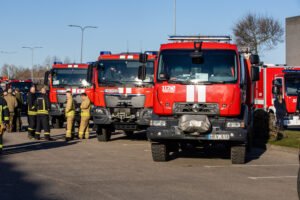
State- level emergency exercise at Achema: response to drone attack and large-scale chemical incident tested
On 2 April, the Achema fertiliser and chemical production plant is hosting the largest state-level civil protection exercise of the year. The drill assesses, under realistic conditions, the readiness of national institutions to respond to a complex hybrid incident involving a drone attack, fire, and a large-scale chemical accident. The scale of the exercise is considerable: more than 150 emergency service personnel are deployed within the Achema site, while around 100 additional specialists are working across various operations centres.
According to the scenario, an unmanned aerial vehicle enters the plant’s territory in the morning and strikes a calcium ammonium nitrate storage facility, causing a fire. Forty-five minutes later, a second drone damages an ammonia storage pipeline, resulting in an ammonia leak. A toxic gas cloud forms and, carried by wind, begins moving towards nearby residential areas. The situation also involves injured and contaminated workers and is treated as a rapidly escalating, multi-layered crisis potentially affecting several municipalities.
The scenario further assumes risk to settlements in the Jonava district, with a potential spread of contamination towards the Kaišiadorys district. It also includes the possibility of a large-scale ammonia release and further escalation, including repeated drone attacks.
“Exercises of this scale allow us to assess how the national crisis management system functions in real conditions. The key today is the ability to act swiftly, in a coordinated manner, and to ensure public safety when multiple threats occur simultaneously,” said Minister of the Interior Vladislav Kondratovič.
The exercise tests the entire response chain – from initial emergency response and operational command centres to decision-making, public warning, and the organisation of civil protection measures. Authorities are evaluating how institutions share information in real time, coordinate actions, and manage a rapidly evolving situation.
“These exercises give us a practical opportunity to test our readiness for complex, multi-layered incidents. It is essential to assess how quickly we respond, how operational management functions, how we coordinate with other institutions, and how effectively we ensure public alerting and protection,” emphasised Renatas Požėla, Director of the Fire and Rescue Department.
The exercise involves key civil protection forces, including fire and rescue services, police, the Anti-Terrorist Operations Unit “Aras,” the Public Security Service, the Lithuanian Armed Forces, emergency medical and public health services, environmental and meteorological agencies, the Jonava and Kaišiadorys district municipalities, the General Assistance Centre, and Achema AB.
During the exercise, the Fire and Rescue Department coordinates inter-agency response, organises public warning and information dissemination, assesses the evolving situation, and plans civil protection measures and rescue operations. The effectiveness of the company’s internal emergency plan and municipal preparedness to protect the population is also being tested.
The exercise is being observed and evaluated by representatives of crisis management and civil protection authorities.