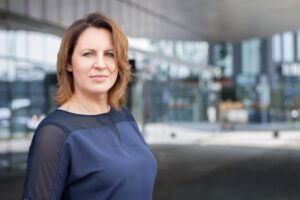
The CEO of “Achema”: the EU fertilizer industry has been stuck in a closed circle
“I do not know a single fertilizer factory in the European Union which currently would be able to operate at the full capacity. Due to the circumstances faced, it seems that in the long run this branch of industry should go entirely extinct,” stated the Chief Executive Officer of AB “Achema”, nitrogen fertilizer and other chemical product manufacturer located in Jonava, which is managed by concern “Achema Group” Audronė Kuskytė. The company is not at its prime right now as for two years it has been operating unprofitably, nevertheless, the CEO highlights at least a couple of significant circumstances which might assist “Achema” in regaining momentum.
This August after a three-month intermission “Achema” renewed the manufacturing of ammonia, which is the main product of the company. The suspension of ammonia manufacturing became an illustration, what economic difficulties are currently faced by not only “Achema”, but the entire EU fertilizer industry. The CEO of “Achema” A. Kuskytė shared frank and wide-ranging insights on current situation not only in the fertilizer branch, but in the entire EU industry sector with website VŽ.LT of “Verslo žinios”.
– During your previous public statements you have already mentioned, that one of the biggest challenges faced by the EU fertilizer industry and your company as well is retaining the competitiveness. Sometimes it is impossible to succeed. What causes the threats for competitiveness?
I am talking about import of cheap fertilizers to the EU from third countries, especially Russia, and unequal competition on the global scale, which are especially aggravated for the European manufacturers by the high environmental taxes. These are the main factors due to which our position in the competitive environment is unstable.
When the EU ratified the Green Deal, the pollution tax in the Union increased and now it amounts to 70-80 EUR approximately per one pollution unit. For the sake of comparison an analogical tax in China amounts to 10 EUR approximately, whereas Russia does not pay such a tax at all, moreover, this country has own raw materials and energy resources.
It is interesting that in Australia pollution tax is not compulsory at all and the companies pay it on voluntary basis due to reputation or other, possibly business culture, causes. Right after Brexit took place the United Kingdom started decreasing the environmental tax, which currently equals approximately 50 pounds. When calculating the global average of the environmental tax average, it equals 2 EUR. If you intend to produce one ton of fertilizers in Europe, you are liable to pay one pollution tax unit. This respectfully means that our production cost for one ton, in comparison to the global market, increases by 70-80 EUR. Under such market conditions it is difficult to talk about the competitiveness of the EU fertilizer industry on the global level.
– It is rather bold to be critical of the Green Deal, especially bearing in mind that the EU is strongly committed to follow the green economy course, unlike many other regions of the world. What conditions do you think the manufacturers needs in order for them to adjust to the Green Deal goals?
When the Green Deal was ratified, it was expected that the European industry will expand and develop. It was also anticipated that the remaining world would follow the European example and introduce the same Green Deal requirements. However, many unfortunate circumstances coincided as the energy resource prices leaped, the prices of raw materials went up along with those of the human resources. It is difficult or even impossible for the EU industry to compete with the countries, where the activity costs are significantly lower.
I am convinced that the EU manufacturers may support the Green Deal concept, but own market should be protected. Not only the requirements should be introduced, since tools are also necessary to assist in dealing with unfavourable circumstances and retain the competitiveness. Unfortunately, this part was lost somewhere along the way. We got stuck in a closed circle: seeking to pollute less we must work more efficiently and modernise the manufacturing procedure, which in turn means significant investments. The problem is that we do not earn enough for these investments, since we are not competitive.
The industry may renounce the gas and operate using only the green energy, but it is necessary to take into consideration that such solution would be expensive and there would be no more money for anything: education, health protection, defence.
– What solution do you see? What tools would support enhancing the competitiveness of the industry?
The EU is already taking steps to create better working conditions for European manufacturers. The first step is the introduction of import quotas and tariffs on production imported from Russia from the 1st of July 1.
The main cause why we had to temporarily suspend the production of ammonia was actually the import of Russian fertilizers. Before introducing new tariffs, it was not economically feasible for us to manufacture this product, because such action would have generated even larger loss for the company without creating any additional value.
The outcomes of imposing tariffs on Russian fertilizers are evident already. This year, during the first half of the year, the import of fertilizers from Russian to the EU increased by 40-50 percent in comparison to the same period last year. Since the 1st of July the import of Russian fertilizers have started to decrease already. Nonetheless, it is still concerning that Russian fertilizer manufacturers will make attempts to bypass the restrictions by taking advantage of other Eastern region countries.
The second solution which we eagerly await is border Carbon Border Adjustment Mechanism (CBAM), imposed upon import from certain third parties.
Which basically means that the importers willing to import their production into the EU also have to cover a certain part of the pollution tax. It should be noted that so far it will be smaller in comparison to one pollution tax unit paid by the EU manufacturers and should amount to approximately 40 EUR per ton (calculated for urea). Nevertheless, that would be good news for us and would enable us to act.
There are also some risks. CBAM would be a very attractive tool for the EU manufacturers, unfortunately for the processors operating in the Union, which import all the raw materials, this tax would become a burden. We are worried that the border tax might be revoked or postponed.
– Can we state that the EU industry, including your company is entirely dependent on the political decisions?
No, that is not the only thing that determines the survival of the industrial companies. The solutions made at the highest level are very significant, nevertheless, despite their difficulties the companies themselves must increase the efficiency, make better use of the available resources. We are currently at a stage when we must input maximum effort even for the sake of the smallest victory. There is no single success factor, there is only work and more work.
– You are well aware of the arguments that the opponents usually provide: fertilizer industry generates a lot of pollution, maybe there is no harm in decreasing it or allowing to gradually go into extinction. The green ideas seem very attractive and socially responsible. What are the methods you invoke for refuting the critics of your opponents?
Yes, we as chemical branch of industry and our manufacturing procedures do generate CO2. But if we are eliminated, the EU would become entirely dependent on the imported goods. Whether we want it or not, we must accept that the fertilizers constitute an integral part of the food chain, even if indirectly, if the fertilizers are eliminated, no good and high quality harvest would be grown, the price of grain, flour and ultimately bread would increase. That is just the path that our bread follows as I put it. Therefore, having a fertilizer manufacturer in the Baltic States enables us to be flexible and prompt in providing the farmers with the necessary products which in turn is a huge advantage.
Another yes, because if no tools are created at the EU scale, enabling the industry to enhance competitiveness, in the long perspective it might mean that we may have to give up the fertilizer industry.
We can also discuss another aspect – green energy has its own consequences: utilisation of batteries or wings of the wind power plants will have serious consequences for the environment. But we should better not elaborate on the matter and allow scientists to comment it.
– Despite economic and other arguments, we sometimes hear hyperbolized statements about “Achema”, which are made absolute, for example, when discussing pollution, it’s always “Achema”, when any incident takes place in “Achema”, it is always escalated to a major drama, despite the actual size of the incident. Do you also notice such tendencies and what is your attitude towards them?
For me as a manager and a person with economic background it is not easy to accept such assumptions. We are not just one factory, we unite an entire group of interconnected companies, most of which are successfully operating. Any failures of “Achema” would have both direct and indirect outcomes as many other business companies would be negatively affected: from construction companies, which are entrusted with our orders, to simple diners in Jonava as they would no longer have clients coming in to eat. I do not understand the recent tendencies to consider business as evil, while it actually creates workplaces, promotes and support various projects, ensures income for the employees.
– The EU has singled out the production of green hydrogen as one of the priorities in the economic development. It is believed to bring a possible breakthrough in many industries. Maybe green hydrogen is also an additional chance at success for “Achema”?
We have studied this field very thoroughly, allocated a lot of time and financial resources for this matter, but we keep on facing several essential questions. The price of our product would increase 3-4 times, if we use green hydrogen. How would we be able to offer our product to the consumer? The product itself does not change due to usage of green hydrogen in the production neither does it gain any added value. Thus, I miss some incentive for the consumers to purchase green products. Currently our consumers are not ready to pay several times more only because green resources are used for manufacturing the product.
Furthermore, the EU regulations are rather strict and complicated as it has been established that green hydrogen must be manufactured using 100 percent of renewable resources, natural gas must also be used. To my mind, the implementation of these requirements is almost unfeasible technically. We are aware of Lithuanian climate: the sun either sines or not, the wind either blows or not. In order to ensure that we always have green energy resources available, we have to install powerful energy storage devices, which is again a huge investment. Another closed circle.
– You had an opportunity to receive the EU support for green hydrogen project, but you declined. Why?
“Achema” was able to receive a funding of 120 million EUR for this project, nevertheless, the total value of the project exceeded a billion EUR. Furthermore, we would have been liable to prove the meaningfulness and economic benefit of the project to the banks in order to ensure the necessary funding. We decided that so far, the implementation of such project would not be economically feasible.
– “Achema” currently has more than 1000 employees, who hear about and witness the situation of the company and, most probably, comment it themselves. Do you feel any shift in their moods, expectations and how you maintain communication with the employees?
I talk to people – some of them are more positive, while others more critical. My principle is to avoid lying and promising anything that is impossible to achieve. I understand that there might be various expectations among the employees, but when I do not have the means to fulfil them, I notify them very frankly. I try to clearly identify the realistic goals of the of the company as well as to provide arguments, why such goal was selected, how it will be achieved. I am happy that most of our employees believe that we are able to achieve the expected results.
– It is expected that “Achema” will end this year without any losses, although with no profits earned either. How would you assess it, is more an achievement or simply an attempt to survive?
I believe it to be a great achievement, nevertheless, there are many perspectives for people to see it, since while there is no profit, how can such situation be positive. However, witnessing the greatness of efforts put into striving towards better results, I am convinced that financially neutral year brings optimism regarding the future of “Achema”.
https://www.vz.lt/pramone/2025/10/07/achemos-vadove-es-trasu-pramone-uzstrigusi-uzdarame-rate-573944